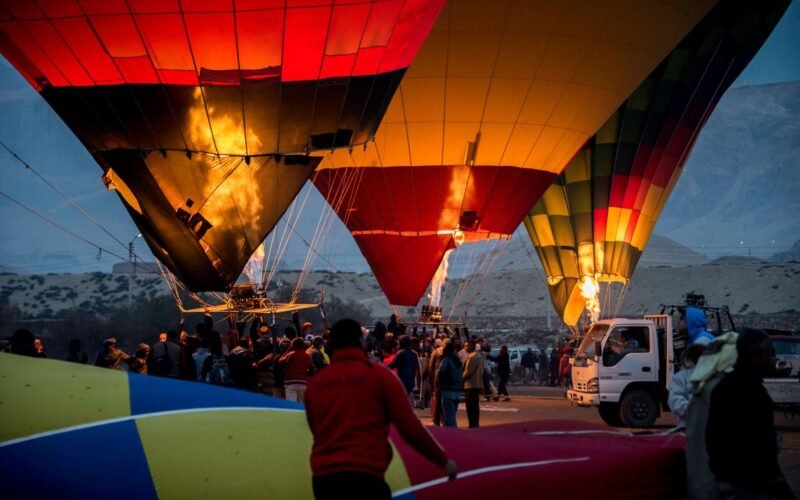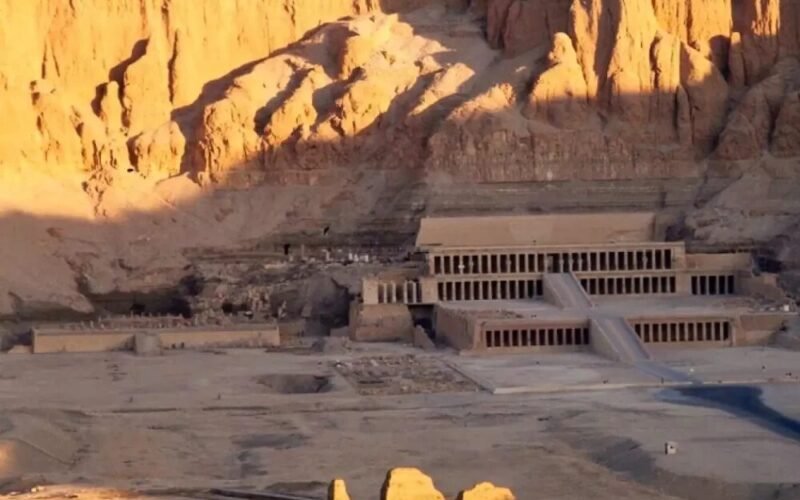
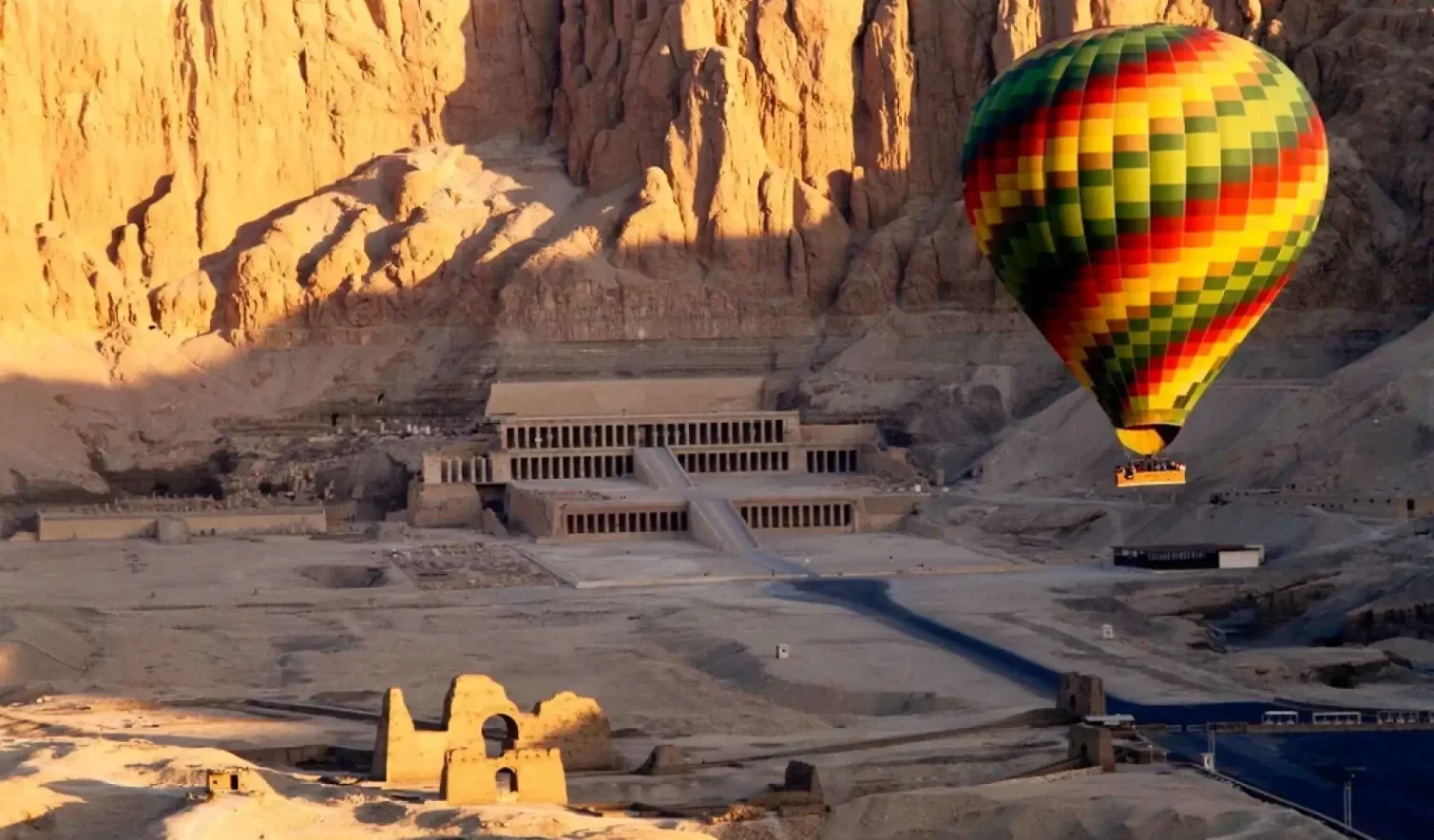
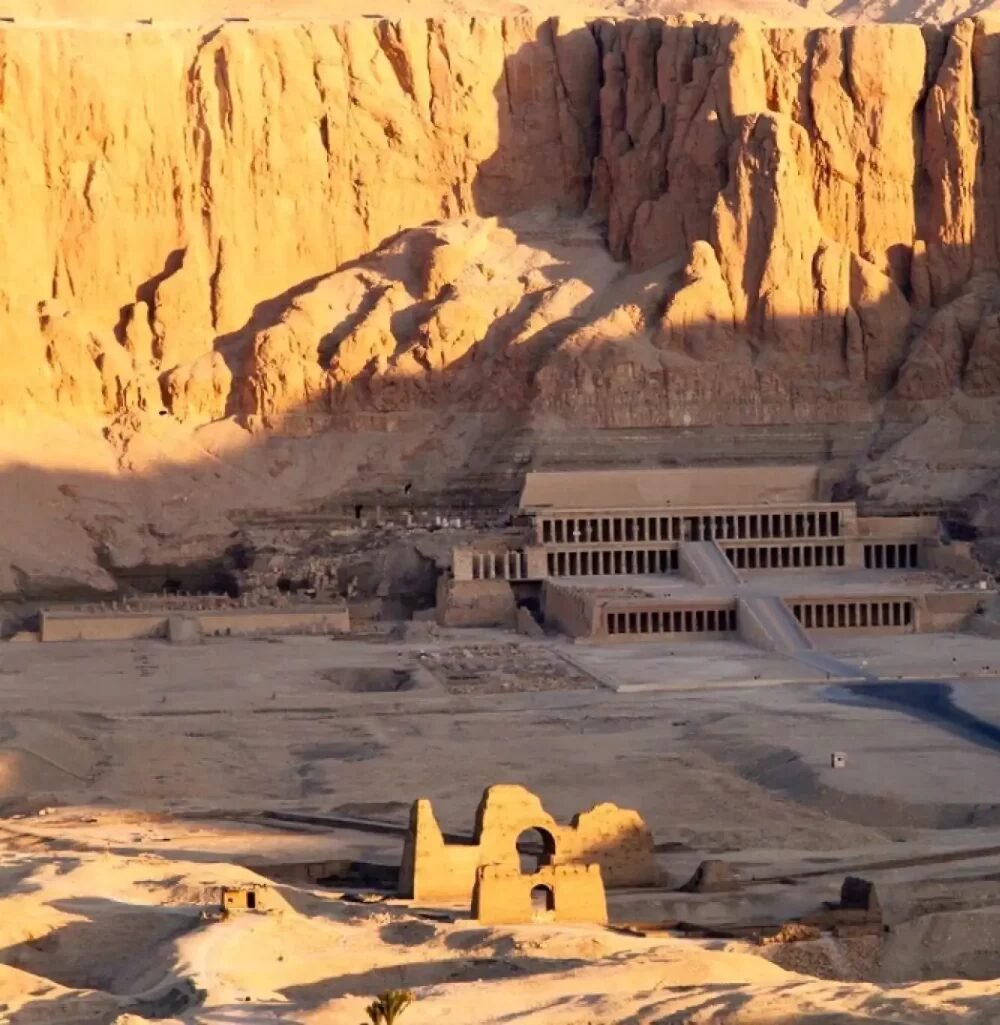
From a balloon over Luxor’s West Bank, one building stops conversation in the basket: three long terraces cut into a wall of golden cliffs, catching the first light of the day. That is the mortuary temple of Hatshepsut at Deir el-Bahari — and it is even better understood from the air than from the ground. Here is who built it, what to look for, and how to visit it after your flight.
Who was Hatshepsut?
Hatshepsut was one of the very few women to rule ancient Egypt as pharaoh in her own right. A daughter of Thutmose I, she became regent for her young stepson Thutmose III and then, around 1479 BC, took the full titles of king. Her reign of roughly two decades during the 18th Dynasty was peaceful and prosperous, remembered for building projects and trade rather than war.
She is often depicted in the dress of a male king, including the false beard — not as disguise, but because that was what the office of pharaoh looked like. After her death, many of her images were defaced and her name removed from monuments, probably late in Thutmose III’s reign. Much of what visitors see today has been painstakingly restored.
Why the temple looks the way it does
The temple, called Djeser-Djeseru — “Holy of Holies” — is credited to her steward and architect Senenmut. It rises in three colonnaded terraces connected by long ramps, set directly against the cliffs of Deir el-Bahari. Behind those cliffs, on the other side of the mountain, lies the Valley of the Kings. The design is so modern-looking that first-time visitors often assume it was rebuilt from scratch; in reality it is ancient, restored by Egyptian and Polish teams over many decades.
What you see from the balloon
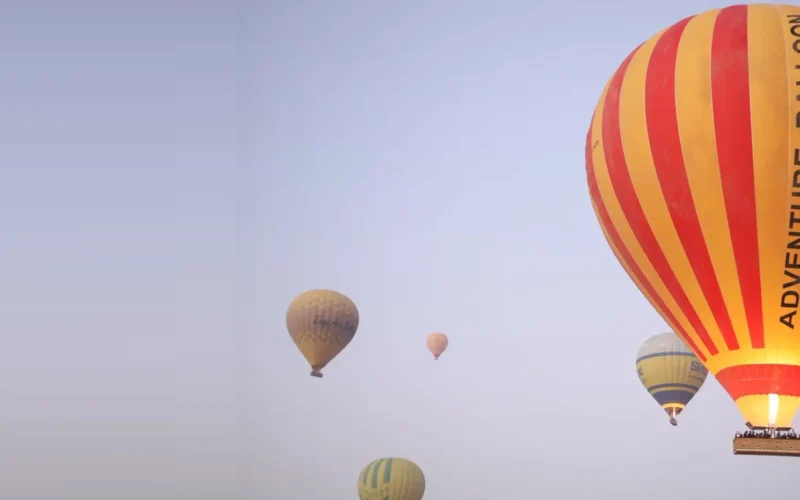
On most mornings the wind carries balloons westward from the launch fields towards the hills, which puts Deir el-Bahari in view for a good part of the flight. From above you can see things that are invisible on the ground:
- The full geometry of the three terraces and ramps, aligned towards Karnak across the river
- The ruins of the neighbouring temple of Mentuhotep II, which inspired Hatshepsut’s design
- The causeway line running out towards the cultivation
- The cliff path over the mountain that leads to the Valley of the Kings
Our article on what you see from a balloon over the Valley of the Kings explains the usual order in which the monuments appear.
Visiting on foot: what to look for
- The Punt reliefs on the middle terrace, showing Hatshepsut’s famous trading expedition to the land of Punt — ships, incense trees, and exotic animals.
- The birth colonnade, telling the story of her divine conception by the god Amun, a carefully crafted claim to the throne.
- The Chapel of Hathor, with columns topped by the cow-eared face of the goddess.
- The Chapel of Anubis, where some of the best-preserved colour in the temple survives.
- The upper terrace with its Osiride statues of the queen and the sanctuary cut into the rock.
Practical tips
- Go early. The temple faces east and the courtyard has almost no shade. After a sunrise balloon flight you are on the West Bank already — it is the perfect time.
- Allow about an hour, more if you love reliefs.
- Bring water and a hat, even in winter.
- Tickets are bought at the site; check current prices and opening hours before you go, as they change.
- Go with a guide if you can. The reliefs make far more sense with someone pointing at them.
Balloon in the morning, Hatshepsut after breakfast
The simplest way to do both is our Hot Air Balloon + Valley of the Kings tour: fly over the necropolis at sunrise, then walk into it with an Egyptologist — Valley of the Kings, Hatshepsut’s temple and the Colossi of Memnon. For both banks in one day, see Balloon + Best of Luxor.
Frequently asked questions
Can you see Hatshepsut’s temple from the hot air balloon?
On most mornings, yes. The exact route depends on the wind, but Deir el-Bahari is one of the landmarks most often seen from Luxor balloons.
How far is the temple from the Valley of the Kings?
About 5 km by road, but only a short distance as the crow flies — a footpath crosses the mountain between them.
Why is it called a mortuary temple if she is not buried there?
Mortuary temples were for the cult of the dead ruler, where offerings continued after death. The burial itself was in a separate tomb in the Valley of the Kings.